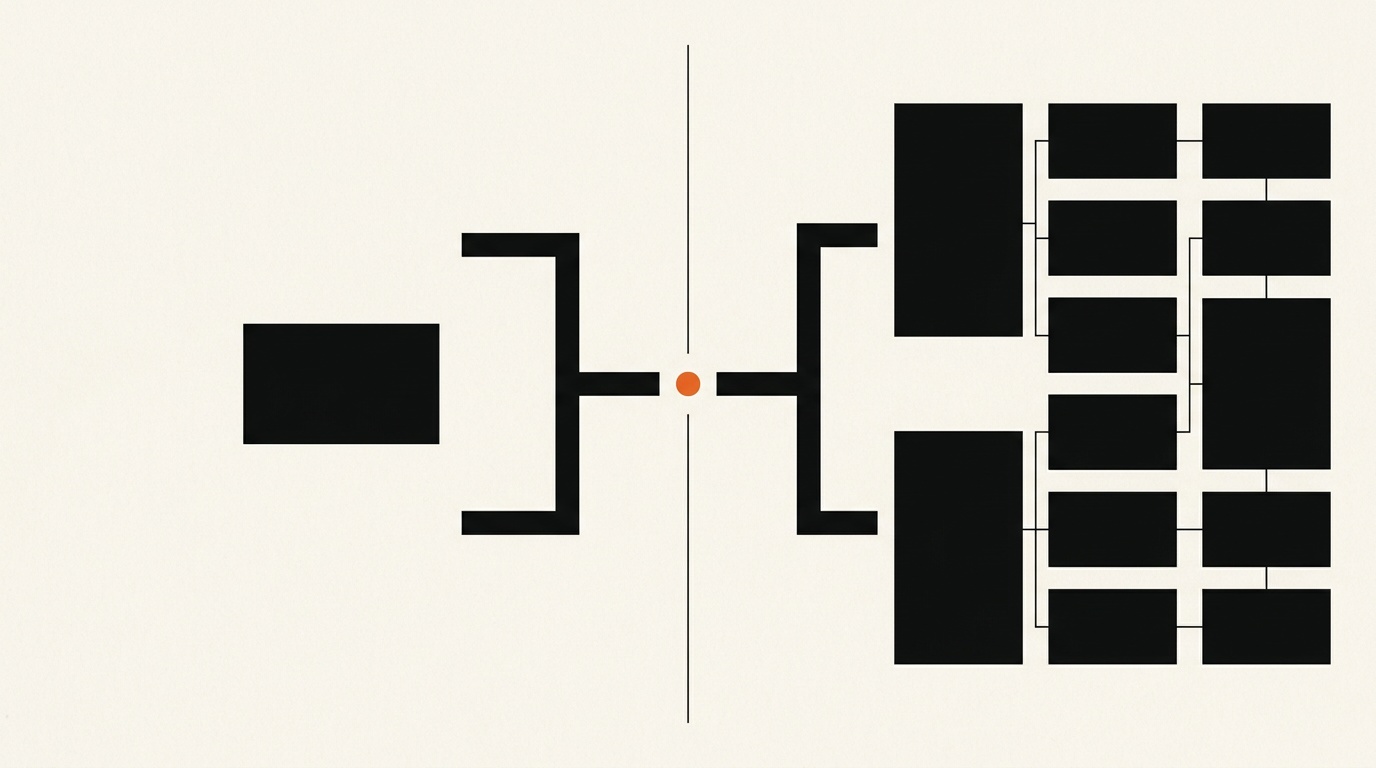
For most small businesses, a freelancer is the more practical choice: lower cost, direct communication, and one person accountable for the whole project. An agency makes sense when the project is complex enough to genuinely need a coordinated team, or when ongoing support and vendor accountability matter more than budget. The decision comes down to project scope, how much management overhead you can absorb, and whether the premium buys you something you actually need.
What you are actually comparing
A freelancer is one person. They scope the project, do the work, and handle questions directly. You talk to the builder.
An agency is a business with employees, overhead, and a process for managing clients. Your contact is usually an account manager. The designer is someone else. The developer may be someone else again.
Neither of those structures is inherently better. Both can produce a good website. Both can produce a bad one. The structure shapes the experience you will have and the price you will pay, but it does not guarantee quality in either direction.
Cost
Freelancers charge less. That is a fact, not a pitch.
For a typical small-business site, five to ten pages, service descriptions, contact form, basic local search setup, a competent freelancer charges somewhere between $2,000 and $10,000. Agencies with comparable output commonly start at $8,000 to $15,000, and many established firms will not take a project under that threshold. Larger agencies in major markets can charge $25,000 to $50,000 for the same deliverable.
The difference is not because agencies do more work. It is because agencies carry real overhead: salaries for account managers, project managers, creative directors, developers, office space, sales staff, and business development costs. When you hire an agency, you are paying for that infrastructure whether your project uses it or not.
The BLS reports that the median annual wage for web and digital interface designers was $98,090 in May 2024. An agency billing you for that designer's time is also billing for everyone around them.
If budget is tight, a freelancer is not a compromise. It is a more direct path to the same output.
Who actually does the work
This is the question most buyers do not think to ask.
At an agency, the person who sold you the project is rarely the person building it. The pitch team shows you senior work. The active project gets assigned based on availability, which often means a junior or mid-level designer supervised by someone with more experience. Your feedback travels through an account manager, who relays it to the creative team, who interprets it. Clutch notes that a common challenge with agencies is that your only point of contact is an account manager, and messages can get misunderstood in the relay.
With a freelancer, whoever you hired is the person working on your site. If you hired someone with 15 years of experience and a portfolio that matches what you need, that person is doing the work. There is no relay.
That direct line has practical value: feedback lands faster, decisions get made in one conversation, and the person who understood your brief in week one is still the person building in week four.
Communication
A freelancer communicates directly with you. An agency typically routes communication through an account manager, which adds a step.
That step can protect you. A good account manager keeps a project organized, documents decisions, and keeps the creative team focused. In a complex project with many moving parts, that structure is worth having.
But for a five-page small-business site, the account manager layer can slow things down without adding much. You ask a question, the account manager asks the designer, the designer responds, the account manager translates. A revision that a freelancer could turn around in a day may take three days through that chain.
Smashing Magazine documented this dynamic years ago and the pattern has not changed: when the account manager becomes the sole conduit between client and designer, communication quality drops. The best agencies address this by letting clients talk to designers directly. Many do not.
What freelancers are worse at
Be honest about the gaps.
A single person cannot hold multiple complex threads at once. If your project involves custom application development, complex integrations, a separate brand identity workstream, and an ongoing content operation, a freelancer is probably not the right answer. They can do one thing well. They cannot scale.
Availability is also a real risk. A freelancer who gets sick, overcommits to other clients, or decides to take a two-week vacation in the middle of your project is a problem you have no escalation path for. An agency has built-in redundancy.
And if you need a long-term support contract, documented processes, a named point of contact at all hours, and SLA-backed response times, an agency is built for that. A freelancer is not.
What agencies are worse at
Agencies are worse at keeping small projects as a priority.
Most agencies prefer larger engagements. A small five-page site is not their dream client. It may get assigned to the most junior available person, scheduled in between larger projects, or stretched to fill a timeline that pads the billing. Clutch acknowledges this plainly: many agencies prefer larger projects over smaller ones, and a small project may not get their full attention.
The agency's reputation was built on work you saw in their portfolio. That work may have been done by a creative director who now manages four other clients. Your project may not look like that portfolio.
Agencies are also worse at moving fast when the client needs to. Fixed business hours, internal review cycles, and multiple stakeholders on the agency side all add friction. A freelancer with a clear brief can move.
Comparison
| Factor | Freelancer | Agency |
|---|---|---|
| Cost | Lower. No overhead passed to client. | Higher. Overhead is always in the rate. |
| Who does the work | The person you hired. | Assigned based on availability; often junior. |
| Communication | Direct, one person. | Through account manager; adds relay steps. |
| Speed | Faster for simple scopes. | More structured but more process. |
| Complexity ceiling | Limited by one person's capacity. | Can staff up; handles parallel workstreams. |
| Ongoing support | Varies; usually informal. | More formal; contracts, SLAs possible. |
| Accountability | One person owns everything. | Distributed; someone is always available. |
| Best for | Small-to-mid projects, direct budgets. | Complex builds, enterprise accountability needs. |
Which should you choose
Choose a freelancer if your project is a small-to-mid business site, your budget is under $10,000, and you want direct communication with the person doing the work.
Choose an agency if your project involves multiple simultaneous workstreams that genuinely require a team, you need a long-term support contract with accountability structures, or internal stakeholders require a vendor with formal processes and named contacts.
In either case: ask who will actually do the work before you sign anything. Ask to see examples of sites the specific person built, not just the agency's portfolio. Ask what happens if that person is unavailable mid-project.
A good freelancer and a good agency can both deliver a site that works. The difference is in the structure around the work, the price you pay for it, and how much of your own time you want to spend managing the relationship.
If you are a small business in Milwaukee and the project is a clearer, faster website that explains what you do and supports local search, a freelancer is almost always the better fit. That is what I do: design the thing and build the thing, so the approved direction does not get lost on the way to production.
If you are not sure whether your current site is doing its job, a free website and visibility audit is a good starting point.
Frequently asked questions
- How much does a freelance web designer charge versus an agency?
- Freelancers typically charge $2,000 to $10,000 for a small-business website project, while agencies commonly start at $8,000 to $15,000 for comparable work, with larger agencies charging $25,000 and up. The gap reflects overhead: agencies carry staff, office, account management, and sales costs that freelancers do not. For a five-page service site, the work itself is similar. The price difference is mostly structure.
- Who actually does the work when you hire a web design agency?
- Usually a junior or mid-level designer, with oversight from a creative director and day-to-day communication routed through an account manager. The senior talent you saw in the pitch may not touch your project. With a freelancer, whoever you hired is the person building it. There is no relay.
- Is it riskier to hire a freelancer than an agency?
- Both carry real risks. An agency can assign your project to a junior team, bury it in their backlog, or lock you into a long retainer. A freelancer can get overcommitted, go dark, or lack the depth to handle something complex. The safest move is to vet the actual portfolio and ask exactly who will be doing the work before signing anything, regardless of which path you take.
- When does an agency make more sense than a freelancer?
- An agency is worth the premium when your project is complex enough to need multiple specialists working in parallel, when ongoing monthly maintenance and support are critical, or when you need a vendor with documented processes and accountability structures for internal stakeholders. Large e-commerce builds, custom web applications, and sites tied directly to enterprise revenue often justify agency pricing.
- Can a freelancer handle design AND development?
- Some can. Look for a freelancer who explicitly shows both design work and live-built sites in their portfolio, not just mockups. A designer who hands off to a developer adds a step where intent gets diluted. Someone who designs and builds the same project keeps the approved direction intact all the way to launch.
- How do I find a good freelance web designer in Milwaukee?
- Ask for referrals from other local business owners first. Look at the live site alongside the portfolio, not just screenshots. Check that they can explain what they built technically, not just how it looks. A good local freelancer will know the difference between a site that looks good in a presentation and one that actually performs in local search.